Non-isothermal flows
The Non-isothermal flows group extends MigFlow's PFEM-DEM framework for immersed granular flows to configurations where temperature gradients and phase transitions actively drive the dynamics of the system, rather than being passively advected by it. This axis targets any immersed granular problem in which thermal and rheological evolution feed back into the mechanics of the flow — from industrial particulate processes to geophysical flows such as cooling lava. Current studies within the group include the digging of a hot droplet into a granular bed and the folding of a crystallising lava crust, but the underlying numerical machinery is developed to be reusable across future non-isothermal applications. We are actively seeking collaborations with researchers from complementary fields — volcanologists, geologists, and industrial process engineers — to confront and validate our simulations against field and experimental data.
Key Concepts & Methodology
Heat Transfer Models
Since the fluid phase and the grains are tracked separately, so is their temperature. In the fluid, it obeys a standard advection–diffusion balance,
while each grain, tracked individually, carries its own temperature through
What differs from one configuration to the next is how heat crosses an interface — and the framework distinguishes two fundamentally different situations.
-
Fluid-fluid and fluid-ambient interfaces are resolved. When the interface itself is tracked by the mesh — a free surface losing heat to the atmosphere, or the boundary of a droplet — heat transfer is imposed directly on the energy equation as a boundary condition, either a prescribed temperature or a prescribed flux:
$$ T = \hat{T} \qquad \text{or} \qquad \mathbf{q}\cdot\mathbf{n} = h_w\big(\hat{T}_w - T\big). $$ -
Solid-fluid interfaces are unresolved. The boundary layer around each grain is thinner than the fluid mesh and cannot be captured directly, so the exchange has to be reconstructed through a convective correlation instead of computed directly. What that correlation actually looks like depends heavily on the underlying physics and on what the "grain" represents — a sand particle in a dense packed bed and a liquid droplet do not exchange heat with their surroundings the same way, so the correlation is chosen case by case, typically built from a Reynolds–Colburn-type analogy with the drag law rather than reused off the shelf. This convective exchange is currently the group's only mechanism at this interface; extending it to other pathways, such as conduction through the granular contact network (the qcond term above), is ongoing work.
Thermo-rheological Coupling
In non-isothermal flows, the mechanical response of the material is generally inseparable from its thermal history. This shows up directly in the momentum balance, where the viscosity — and, where buoyancy matters, the density — entering the stress tensor are no longer constants but fields that follow the local temperature:
The specific form of $\eta(T)$ is chosen to match the material at hand. Cooling lava, for instance, is captured by a Vogel–Fulcher–Tammann law, whose steep growth as $T$ drops is what turns a cooled surface layer into a crust orders of magnitude stiffer than the fluid core:
This momentum balance is solved together with the energy equation at every time step, so that thermal and mechanical evolution feed back into one another self-consistently rather than being treated as separate, sequential processes.
Modelling of Phase Change
Many non-isothermal flows involve a change of state, whether vaporisation, solidification, or crystallisation, which introduces an additional layer of coupling between the thermal and mechanical fields. Depending on the application, this can take the form of a heat flux entirely consumed by latent heat at a moving interface, or of a progressive rigidification of the material as cohesive bonds form between solidifying particles, potentially followed by fracture once local stresses exceed a given threshold. So far, each mechanism has been implemented for the specific case study that needed it — vaporisation for the digging droplet, a numerical viscosity cap standing in for solidification on the lava crust. Turning phase change into a first-class, reusable part of the model, rather than a bespoke treatment rebuilt for every new application, is active, ongoing work within this axis, and a prerequisite for reproducing emergent behaviours such as localised fluidisation, chimney formation, or crust fracturing directly from the underlying physics.
Ropy Lava Simulation
Supplementary documentation
Ropy Lava Flows (Pāhoehoe)
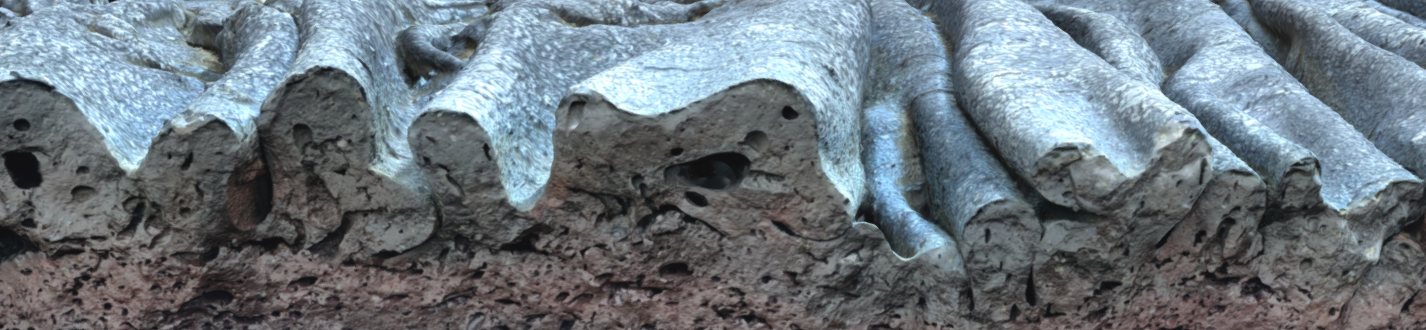
As lava flows, its surface loses heat to the atmosphere and cools below the fluid core, forming a thin, viscous crust. This creates a viscosity contrast across the flow thickness. When the surface is compressed — by the deceleration of the flow front, lateral confinement, or continued advance of fluid behind it — the crust cannot simply shorten, so it buckles instead, producing the wave-like ridges characteristic of ropy pāhoehoe.
A dominant wavelength naturally emerges. As compression continues, the crust buckles again at a larger scale, nesting a second generation of longer folds on top of the first, and this process can repeat to produce hierarchical wrinkling.
This mechanism appears mainly on gentle slopes and at low effusion rates, where the flow advances slowly enough for a continuous crust to form and thicken before being fractured.
Simulation Overview
The model relies on MigFlow's PFEM solver, using a Lagrangian finite-element fluid formulation that is fully remeshed at every time step via an alpha-shape technique to adapt resolution around the free surface. Lava is treated as an incompressible Newtonian fluid whose viscosity follows the Vogel-Fulcher-Tammann (VFT) law, strongly temperature-dependent: this thermo-rheological coupling progressively turns the cooled surface into a highly viscous crust while the core remains fluid. The free surface is tracked explicitly through node advection (ALE method) at each iteration, capturing the propagation dynamics and the folding behavior of the flow under compression.
Key Parameters
Rheology & Thermal
Boundary Conditions
Numerical
Droplet Digging in a Hot Granular Bed
Supplementary documentation
Spontaneous Droplet Digging
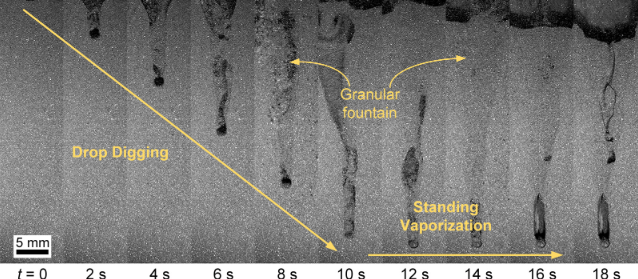
When a water droplet is placed on the surface of a hot granular bed, its fate depends on the bed's temperature. Close to the vaporisation point, the droplet simply collapses onto the surface, transferring heat only to the top grains. At higher temperatures, the vapour produced beneath the droplet locally fluidises the grains: the droplet and its vapour film sink into the fluidised region, ejecting grains upward into a chimney, and progressively digs into the bed.
At even higher temperatures, the thrust of the escaping vapour becomes strong enough to keep the droplet fully suspended above the grains — the Leidenfrost effect — preventing it from ever entering the bed.
This behaviour was first documented experimentally by Lin et al. (2022) in a quasi-2D Hele-Shaw cell, which is the configuration this simulation reproduces.
Simulation Overview
The bed of grains is solved with the non-smooth contact dynamics (DEM/NSCD) solver, while the interstitial air and the droplet share a single volume-averaged Navier–Stokes (VANS) fluid domain, coupled to the grains through a drag law and a matching convective heat transfer correlation. The mesh is semi-resolved around the droplet and coarsens away from it to keep the cost tractable.
Between the grains and the interstitial fluid, this drag and Nusselt-type correlation pair — the concrete instance of the generic solid–fluid law described above, calibrated against packed- and fluidised-bed heat transfer data (Henry et al., 2025) — is what carries the momentum and heat exchange. The droplet itself is not meshed as a separate fluid: it is tracked as a mixture of liquid and absorbed grains whose volume and momentum evolve from the net heat, mass and force balance at its interface, while the surrounding mesh is deformed with it (ALE) and periodically regenerated with GMSH.
The droplet's own interface is treated much like an oversized grain, with one key difference: it sits pinned at its vaporisation temperature, so the net heat it receives never raises its temperature — it is entirely converted into latent heat and consumes the droplet's mass,
where $Q_f$ is the heat received from the surrounding fluid, $Q_p$ the heat received from the grains it has absorbed, and $\mathcal{L}$ the latent heat of vaporisation. Unlike a solid grain, which only exchanges heat with the fluid, this mass loss produces an outward vapour flux at the interface: rather than a Nusselt-type correlation, it is imposed directly as a Dirichlet velocity condition,
with $\mathbf{u}_d$ the droplet velocity, $\rho_v$ the vapour density, $S$ the interface area, and $\hat{\mathbf{r}}$ the outward radial direction. This same vapour feeds the advection–diffusion field $\psi$ that locally suppresses cohesion in the bed wherever it rises above a threshold. It is this genuine mass flux through the interface — absent from a solid grain's heat exchange — that fluidises the bed locally and lets the droplet dig in, rather than simply crash on the surface.
Key Parameters
Fluid Properties
Grain Properties
Vapour & Cohesion
The vapour produced at the droplet's interface spreads outward through the bed as a concentration field $\psi$, governed by its own advection–diffusion equation. Wherever $\psi$ locally exceeds the threshold $\psi^0$, a contact is no longer allowed to carry the cohesive bond $F_c^0$ that otherwise holds neighbouring grains together — this is the mechanism that turns vapour production into local fluidisation.
Geometry
Thermal & Boundary Conditions
Numerical
References & Sources
- [1] Henry, M., Coppin, N., Dorbolo, S., Legat, V. & Lambrechts, J. (2025). Multiscale FEM-DEM model for spontaneous droplet digging in a hot granular bed. International Journal of Heat and Mass Transfer, 241, 126755.
- [2] Lin, F., Dorbolo, S., Wang, W. & Zou, J. (2022). Deep spontaneous penetration of a water droplet into hot granular materials. Physical Review Fluids, 7(3), 034301.