A simulation tool waiting for a real problem
The numerical side of MigFlow — coupled grain contacts, fluid dynamics, and free-surface tracking — is mature and validated. What moves the project forward now is a real system to point it at: a field site, a lab experiment, an industrial process. That's where you come in.
Where MigFlow is genuinely strong
Free surfaces
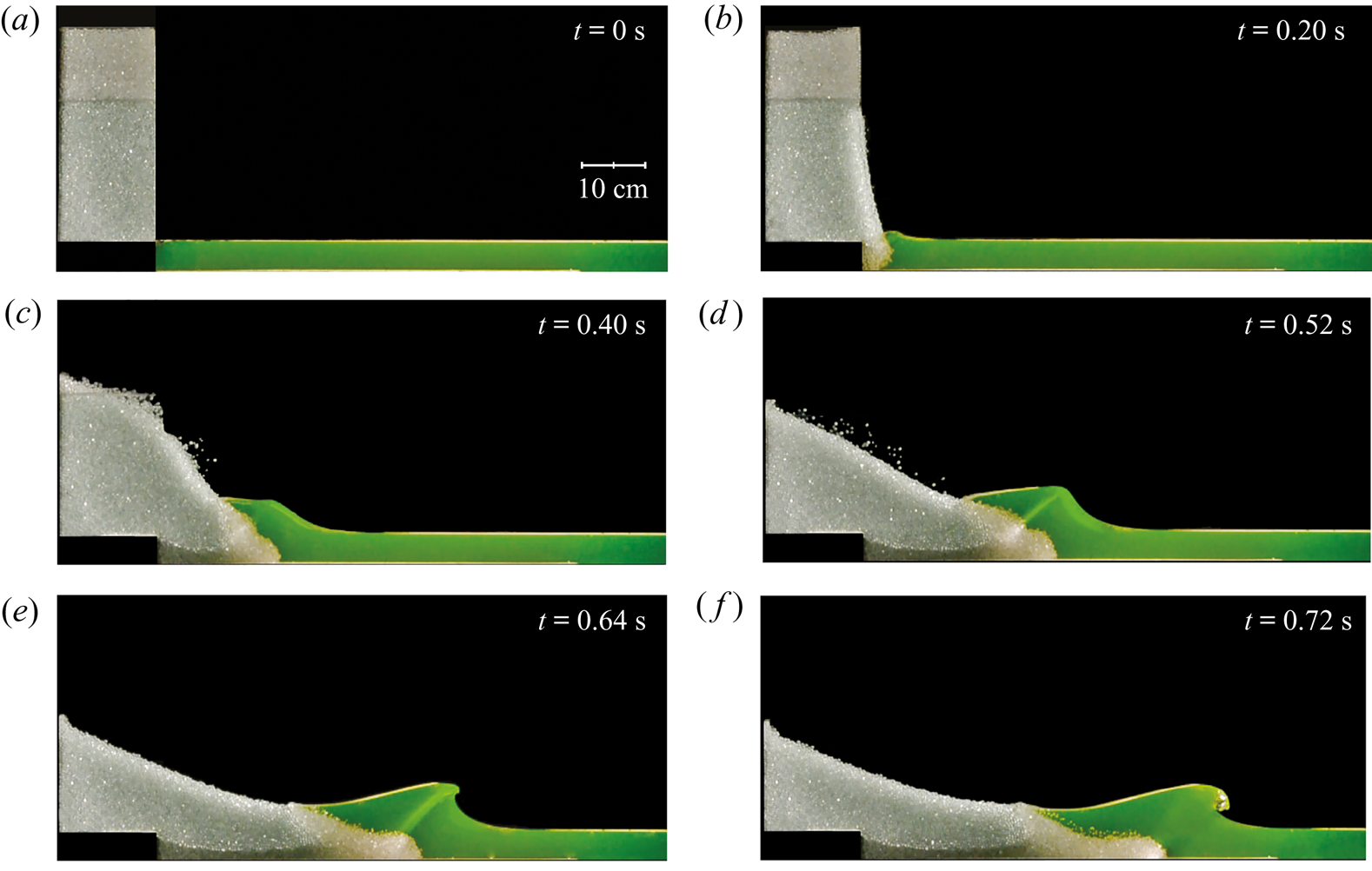
The fluid domain is remeshed as it deforms, so a violently reshaping surface — a wave, a splash, a collapsing column — stays well represented instead of breaking the simulation.
Thermal coupling
Temperature isn't just advected: it feeds back into the fluid's viscosity and density, so heating or cooling genuinely changes how the flow behaves.
Grain–heat coupling
Heat also travels through the grains themselves and their contact network, individually — not just through the surrounding fluid — for problems where the solid phase's temperature matters just as much.
A research code, built to adapt
MigFlow is actively developed, not a fixed commercial tool — new boundary conditions, geometries, or physics for a specific problem can typically be added quickly.
Not our first collaboration
MigFlow itself was born from a partnership between UCLouvain and the University of Montpellier's LMGC, coupling their respective finite element and discrete element codes. That partnership is still active today.
After the Journées Complex Flows 2026 in Clermont-Ferrand, we started a collaboration with Karim Kelfoun and the local volcanology community — our first step toward confronting the lava and landslide simulations with real field data.
Any problem that mixes grains and fluid interests us
Volcanology and geology — lava flows, landslides, granular geohazards — are a natural fit, but immersed granular flows show up everywhere solids and fluids mix: sediment transport, industrial and chemical processing, pharmaceutical and agro-food formulation, and plenty we haven't thought of yet. If you have a problem or a dataset in mind, tell us about it.
Suggest a collaboration →